
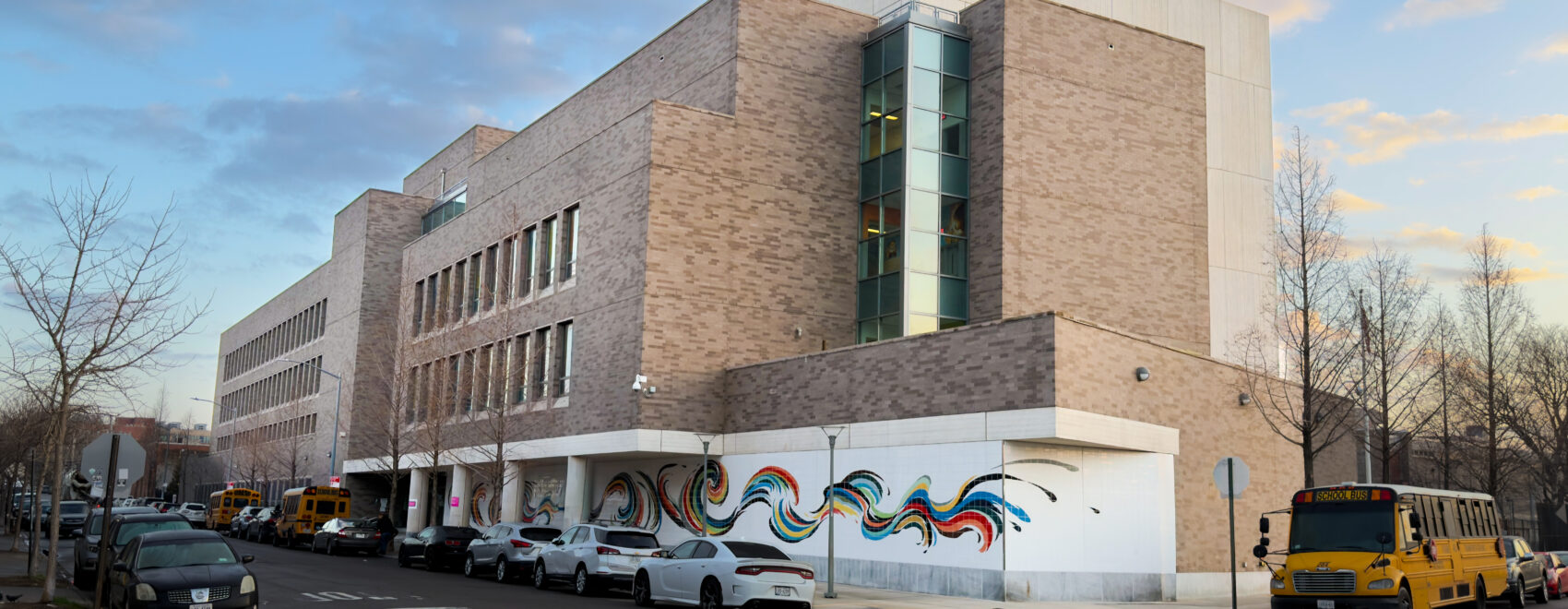
Concrete masonry unit (CMU) construction is widely used throughout commercial construction because it combines structural performance, fire resistance, impact resistance, and long-term reliability within a single wall assembly.
In schools, hospitals, municipal facilities, and other high-occupancy public buildings, reinforced CMU walls help support the demanding performance requirements these structures face every day.
Across New York City, Long Island, and the surrounding region, reinforced masonry construction is commonly used in projects where buildings must operate continuously, support large occupant loads, and withstand decades of use with minimal maintenance. From classrooms and medical centers to fire stations and public facilities, CMU remains one of the most widely specified wall systems in commercial construction today.
What Is CMU Construction?
CMU stands for concrete masonry unit, commonly referred to as concrete block or block construction. These units are stacked together using mortar to create structural or non-structural walls within commercial buildings.
On many commercial projects, CMU wall systems are reinforced internally using:
- Vertical reinforcing steel
- Horizontal joint reinforcement
- Grouted cells
- Bond beams
- Reinforced lintels
These reinforced masonry assemblies can serve as:
- Load-bearing walls
- Shaft walls
- Stair towers
- Mechanical room enclosures
- Exterior backup walls
- Partition walls
- Security walls
CMU construction is frequently combined with brick façades, precast systems, curtain wall assemblies, and structural steel framing on large institutional projects.
Why Schools Frequently Use Reinforced CMU and Concrete Block Construction
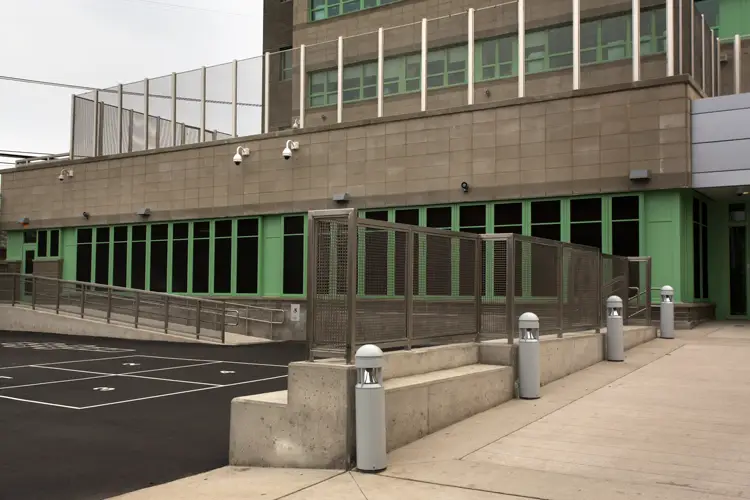
Educational facilities place significant demands on building materials. Public schools, universities, and campus buildings experience constant daily traffic, rolling equipment, furniture movement, and long operating schedules.
Reinforced CMU construction is commonly used in educational construction because it provides:
- Impact resistance in high-traffic corridors and classrooms
- Fire-rated wall assemblies
- Long service life in high-traffic environments
- Acoustic separation between classrooms
- Reduced maintenance requirements
- Resistance to moisture and mold damage
- Efficient construction for large-scale campuses
School construction projects also often involve phased schedules and occupied campuses. Reinforced masonry assemblies help reduce future maintenance demands while supporting decades of facility use.
Giaquinto Masonry has contributed to educational construction projects involving reinforced masonry systems, brick façades, and institutional wall assemblies throughout the New York metropolitan area, including PS 339, a five-story public school in the Bronx developed for the New York City School Construction Authority.
Why Hospitals and Healthcare Facilities Use Reinforced CMU
Hospitals and healthcare environments require building systems that support life safety, sanitation, durability, and continuous operation. Many healthcare facilities operate 24 hours a day and cannot tolerate frequent structural repairs or building envelope failures.
Reinforced CMU assemblies are commonly used in healthcare construction because they provide:
- Fire resistance between critical building areas
- Acoustic separation for patient privacy
- Structural durability in demanding environments
- Moisture resistance within service areas
- Long-term performance with reduced maintenance
- Secure enclosures for mechanical and utility systems
Healthcare buildings also require extensive coordination between masonry systems, MEP trades, and medical gas infrastructure. Masonry contractors frequently coordinate around:
- MEP penetrations
- Air and vapor barriers
- Structural framing
- Curtain wall systems
- Infection-control requirements
- Phased occupied construction
These coordination demands become especially important within hospitals, surgical centers, laboratories, and emergency facilities where system reliability is critical.
Projects such as South Shore University Hospital demonstrate the kind of large-scale healthcare construction where reinforced masonry systems must integrate with complex medical facilities, phased expansion work, and continuously operating environments.
Why Municipal Buildings Commonly Use CMU Wall Systems
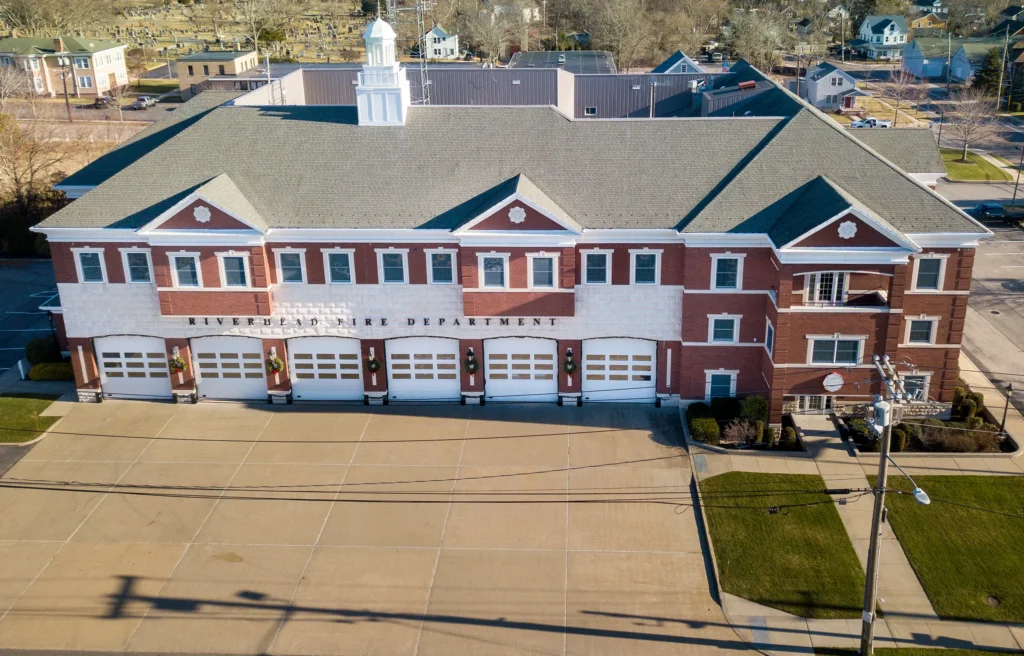
Municipal and civic facilities are often designed for exceptionally long service lives. Buildings such as fire stations, police precincts, public works facilities, transportation centers, and courthouses must withstand constant public use while maintaining structural integrity and life-safety performance.
CMU construction is frequently selected for municipal buildings because it offers:
- Inherent fire resistance
- Strong impact durability
- Secure reinforced wall assemblies
- Resistance to weather exposure
- Long-term structural reliability
- Lower maintenance requirements over time
Many municipal projects also require compliance with strict public-sector specifications, inspection requirements, and security standards. Reinforced masonry assemblies help support these operational and structural requirements within active public facilities.
Projects such as the Massapequa Fire House, Northwell at Jones Beach Theater, and Queen of Peace Cemetery reflect the wide range of civic and municipal environments where durable reinforced masonry systems are commonly used.
Fire Resistance Is One of the Biggest Advantages of CMU Construction
One of the primary reasons reinforced CMU construction is so common in schools, hospitals, and public-sector facilities is fire resistance.
Concrete masonry assemblies are non-combustible and can achieve high fire-resistance ratings when properly designed and constructed. This makes CMU especially valuable in buildings where occupant safety and compartmentalization are critical.
Fire-rated CMU assemblies are commonly used around:
- Stair towers
- Elevator shafts
- Mechanical rooms
- Corridors
- Utility spaces
- Emergency egress pathways
- Equipment enclosures
Schools, hospitals, and municipal buildings all rely heavily on these compartmentalized assemblies to support life-safety requirements and building-code compliance.
Why Acoustic Separation Matters in Schools and Hospitals
Acoustic performance is another major reason CMU remains widely used in commercial construction.
Concrete masonry walls help reduce sound transfer between occupied spaces, making them especially valuable in:
- Classrooms
- Patient rooms
- Medical offices
- Courtrooms
- Offices
- Mechanical rooms
- Public meeting areas
In educational environments, acoustic separation helps reduce distractions and improve learning conditions. In healthcare settings, sound control supports patient privacy and comfort.
CMU Construction Helps Reduce Long-Term Maintenance
Institutional buildings are often expected to remain operational for decades with limited interruption. CMU wall systems provide strong resistance to:
- Daily wear and tear
- Moisture exposure
- Impact damage
- Structural movement
- Weather conditions
- Heavy public use
This long-term durability helps reduce maintenance costs and lifecycle repairs compared to more fragile wall systems.
For many owners, developers, and public agencies, long-term performance becomes a major factor when evaluating commercial wall assemblies during project planning.
Masonry Coordination Is Critical on Large Commercial Projects
While reinforced CMU systems are highly durable, successful installation requires extensive field coordination between multiple trades and building systems.
On large commercial projects, masonry assemblies must integrate with:
- Structural steel
- Reinforced concrete framing
- Curtain wall systems
- Air and vapor barriers
- Flashing systems
- Expansion joints
- Roofing transitions
- MEP penetrations
Early coordination helps reduce field conflicts, sequencing delays, and costly design revisions during active construction.
Giaquinto Masonry provides support through our commercial masonry services, including commercial construction value engineering, masonry constructability review & pre-construction services, and commercial construction costing & masonry cost analysis.